What is the difference between small particle urea and large particle urea? Agricultural Procurement Selection Guide
## What is small particle urea?
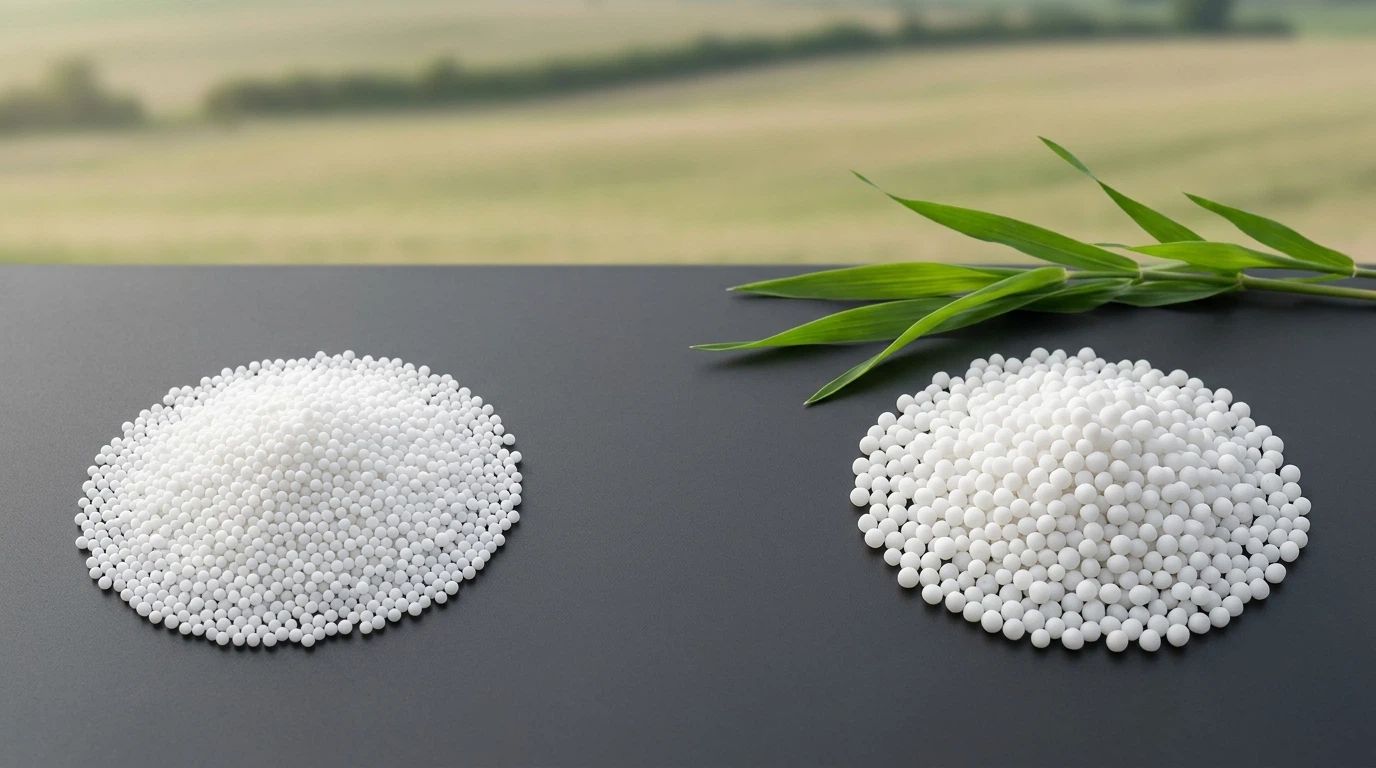
Small particle urea is a smaller particle made by forming molten urea into droplets and cooling it. It is usually called "Prilled Urea" in English. It is widely used as agricultural nitrogen fertilizer and has mature distribution channels in many price-sensitive markets.
The smaller particle shape can be adapted to conventional fertilizer sales and some field fertilization methods. However, when purchasing, you cannot just compare the nitrogen content. You should also confirm indicators such as biuret and particle size distribution based on the quality inspection report (COA) of the supply batch.
When purchasing small granular urea, you usually need to confirm:
- Specific agricultural use of the product
- Required particle size range
- Acceptable biuret index
- Packaging and marking requirements
- Storage and handling conditions
- Import requirements of the destination country
## What is large particle urea?
The particles of large-granular urea are usually larger than those of small-granular urea, and are called "Granular Urea" in English. Agricultural buyers often consider this granular form when the product needs to be mechanically spread, blended, stored or loaded through bulk systems.
The common reference nitrogen content of large particle urea is 46%, and buyers may also put forward requirements such as biuret and a particle size range of 2-4 mm. However, these data are not a fixed guarantee applicable to all goods, and the final indicators should be based on the COA or Technical Data Sheet (TDS) of the actual supplied batch.
Some buyers choose large-particle urea because they pay more attention to particle uniformity, loading and unloading performance, or compatibility with existing fertilization equipment. Particle strength, dust level and actual particle size distribution cannot be judged by the product name "Large Particles" alone. Corresponding information still needs to be checked.
## The main difference between small particle urea and large particle urea
| Comparison items | Small particle urea | Large particle urea |
|---|---|---|
| Particle morphology | Particles are relatively small | Particles are relatively large |
| Reference nitrogen content | Usually 46%, subject to batch COA | Usually 46%, subject to batch COA |
| Common purchasing highlights | Price, specifications, availability and local market preferences | Particle size distribution, handling, mechanical spreading and blending needs |
| Mechanized use | Need to be confirmed with specific equipment | Commonly used in scenes that require mechanical loading and unloading or spreading |
| Dust and crushing | Should be judged based on product data or test results | Should be judged based on product data or test results |
| How to choose | Depends on local needs and application method | Depends on equipment, handling conditions and end use |
The core difference between the two is the physical particle form, not simply the nitrogen content. Even if both products are labeled as urea containing 46% nitrogen, their transportation, storage, blending and field application performance may differ due to different particle characteristics.
## Which type of urea should I purchase?
### Small particle urea can be considered in the following situations
- The local market or end customers clearly require small particle products.
- Smaller particles are suitable for the planned fertilization method.
- The specifications and COA of the supply batch comply with the procurement standards.
- Local sales channels are accustomed to dealing in small-grain agricultural urea.
### Large particle urea can be considered in the following situations
- The product will be spread by mechanical equipment.
- Blending or flow-through systems require larger particle morphologies.
- Particle size distribution is an important quality indicator in the contract.
- Large grain agricultural urea is clearly specified by the end customer.
No one pellet format is better in all markets. A safer way to purchase is to first confirm the end use and then compare quotes based on the same conditions, including product grade, particle size requirements, packaging, quantity, trade terms, destination port and required documents.
## Five specifications you need to confirm before ordering urea
### 1. Nitrogen content
Agricultural urea usually uses a nitrogen content of 46% as a reference specification. The indicators in the formal contract should be consistent with the actual supply batch and its COA.
### 2. Biuret
Biuret is a common quality indicator in urea procurement. Acceptable limits may vary depending on product, use, and buyer standards, and general parameters online should not be taken directly as guaranteed values for the current batch.
### 3. Particle size distribution
"Small particles" and "large particles" are just general descriptions of physical forms. The buyer may require a certain proportion of particles to be within a specified particle size range, so the target particle size and inspection standards should be made clear when enquiring.
### 4. Packaging requirements
The buyer needs to indicate the weight of the single bag, packaging materials, whether pallets are used and the marking language. Specific packaging capabilities and loading options need to be confirmed individually for each quote.
### 5. Documents and destination country requirements
Different countries may have different requirements for import licensing, labeling, inspection and documentation. Providing the destination country and destination port as early as possible will help to verify relevant conditions before making a formal quotation.
## How to correctly compare urea quotes?
If the two quotations adopt different specifications or trade terms, simply comparing prices has no practical meaning. When evaluating supplier quotations, the following conditions should be unified first:
- Clarify whether the product is small particle or large particle agricultural urea
- Required quality specification and particle size range
- Purchase quantity
- Packaging and custom marking requirements
- FOB departure port or CIF destination port
- Payment terms
- Quotation validity period
- Estimated shipping time
- COA, TDS and other required documents
Urea prices, sea freight rates, supply schedules and export conditions are subject to change. Therefore, an executable quotation should be based on clear procurement needs and indicate the validity period.
## What information is required to obtain a valid urea quote?
In order to reduce repeated communication, the buyer can directly provide the following content when making an inquiry:
1. Product type: small or large particle agricultural urea
2. Target specifications, or provide COA used in previous purchases as a reference
3. Purchase quantity in metric tons
4. Packaging requirements
5. Destination country and destination port
6. Trade terms such as FOB or CIF
7. Target shipping time
Once these conditions are clear, the fertilizer export and supply chain team can further verify the current supply schedule, batch information, packaging feasibility and shipping costs, and prepare a formal quotation.
## FAQ
### Is large particle urea better than small particle urea?
uncertain. Large particle urea may be more suitable for some mechanical spreading, blending and loading and unloading systems; small particle urea may be more suitable for certain market channel habits or application methods. Equipment, market needs and target specifications should be considered when selecting.
### Do both small particle urea and large particle urea contain 46% nitrogen?
Both usually use a nitrogen content of 46% as a reference indicator, but the content and other parameters in formal transactions must be based on the contract specifications and the corresponding batch COA.
### What is the usual particle size of large particle urea?
The reference range of 2-4 mm is often discussed in the market, but the specific particle size and distribution requirements that can be supplied are not exactly the same. The buyer should propose a target range and ask the supplier to confirm it based on current product data.
### Can I quote CIF price for urea?
Can. When calculating CIF quotation, product type, quantity, packaging and destination port need to be provided. Sea freight and availability should be verified based on actual conditions at time of quotation.
### What documents should be requested from suppliers when purchasing urea?
Specific documentation depends on the destination country and transaction requirements. Buyers typically review product specifications and COA; additional shipping, safety, inspection, labeling, or import-related documents may be required. It is recommended to confirm the complete list of documents before placing an order.
## Get a quote for small or large granular urea
We are a professional fertilizer export and supply chain service team. To obtain an executable FOB or CIF quotation, please provide the required urea type, specification, quantity, packaging and destination port. We will verify current supply conditions and documentary requirements before preparing a formal quotation.
**Suggested inquiry form:**
> We need to purchase [small granules/large granules] agricultural urea, quantity [___] metric tons, packaging [___], destination port [___], trade term is [FOB/CIF]. Please confirm available specifications and provide a quote.